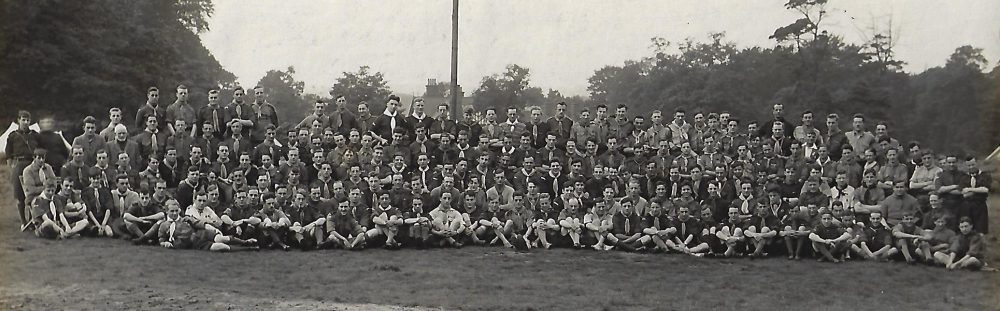
In 1899, during the Second Boar War in South Africa, Baden-Powell successfully defended the town in the Siege of Mafeking. A Boer army of more than 8,000 men surrounded him and his troops. Although wholly outnumbered, the garrison withstood the siege for 217 days, and much of this is attributable to some of the cunning military deceptions instituted at Baden-Powell’s behest as commander of the garrison. As a result, Baden-Powell became a national hero back home.
He recognised a need to prepare young people with skills for life, for citizenship and a sense of belonging.
Aged 50, B-P ran a trial camp on Brownsea Island, off Poole, Dorset, in 1907, and wrote an outline for the proposed Boy Scout movement. On January 24, 1908, the Boy Scouts movement begins in England with the publication of the first instalment of Scouting for Boys. The name Baden-Powell was already well known to many English boys, and thousands of them eagerly bought up the handbook.
He retired from the army in 1910 to devote all his time to the Boy Scouts, and in the same year he and his sister Agnes Baden-Powell (1858–1945) founded the Girl Guides.
His wife, Olave, Lady Baden-Powell (1889–1977), also did much to promote the Girl Guides.
Baden Powell toured the UK and the Commonwealth, speaking with the Great and the Good to mobilise youths into Patrols and Troops (gangs).
Under his leadership, Baden-Powell brought Scouting to the youth of the world and the world Scouting movement grew.
By the end of 1910, there were over 100,000 Scouts in England.
In 1922, there were more than a million scouts in 32 countries and by 1939; the number of Scouts had grown in excess of 3.3 million.
On returning to the UK, Baden-Powell realised that boys at home could benefit from similar sorts of activities to the boys at Mafeking. These activities went on to form the basis of the Scouting Movement.
While Scouting remains relevant, educational and exciting today, it has not strayed too far from its roots; outdoor adventure, helping others and Scouting skills remain the most iconic of its activities.